This blog is based on Jong-han Kim's Linear Algebra
Clustering objective
is group , for
is group that is in:
group representatives: -vectors
clustering objective is
small means good clustering
goal: choose clustering and representatives to minimize
Partitioning the vectors given the representatives
suppose representatives are given how do we assign the vectors to groups, i.e., choose ?
only appears in term
to minimize over , choose so
-means algorithm
alternate between updating the partition, then the representatives
a famous algorithm called k-means
objective decreases in each step
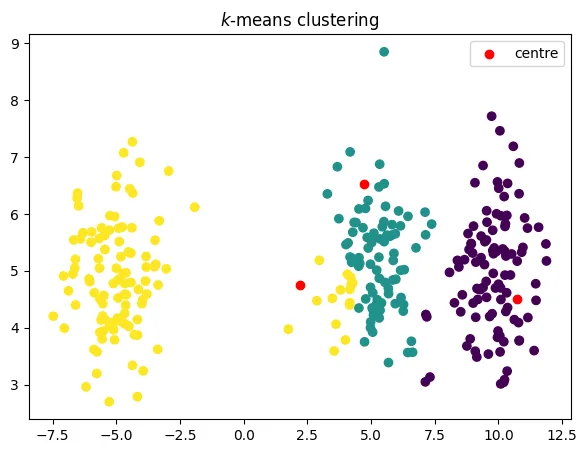
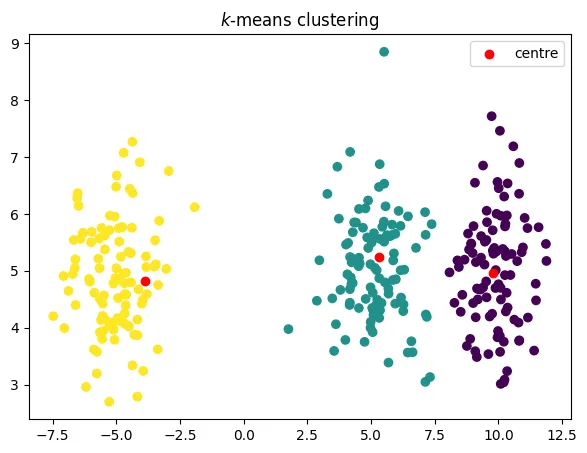
코드
import numpy as np
import matplotlib.pyplot as plt

np.random.seed(42)

data = np.concat([
  np.random.randn(100, 2) + (10, 5),
  np.random.randn(100, 2) + (5, 5),
  np.random.randn(100, 2) + (-5, 5)
])

init_centre = data[0:3]

print(init_centre)

def kmeans(k):
  for i in range(10):
    dist = np.sum(np.sqrt((data[:] - init_centre[:, np.newaxis])**2), axis=2)
    groups = np.argmin(dist, axis=0)

    print(groups)

    old_centroids = init_centre.copy()

    for i in range(k):
        if data[groups == i].shape[0] > 0:
            init_centre[i] = data[groups == i].mean(axis=0)

    if np.abs((init_centre - old_centroids).sum()) < 0.1:
      break

    plt.figure(figsize=(7, 5))
    plt.title("$k$-means clustering")
    plt.scatter(data[:, 0], data[:, 1], c=groups)
    plt.scatter(old_centroids[:, 0], old_centroids[:, 1], c="red", label="centre")
    plt.legend()
    plt.show()

kmeans(3)