This blog is based on Jong-han Kim's Linear Algebra
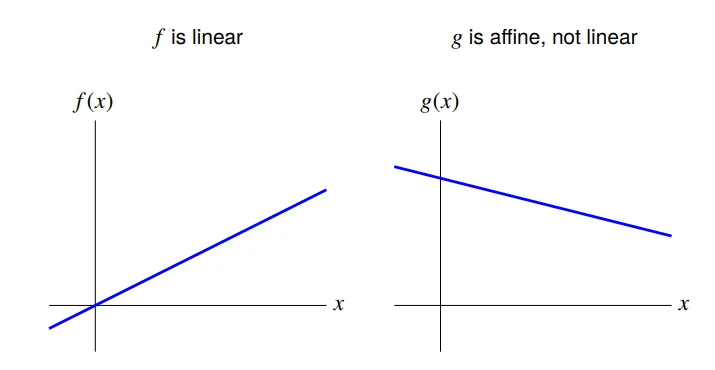
Superposition and linear functions
f:Rn→R
f satisfies the superposition property if
f(αx+βy)=αf(x)+βf(y)
- A function that satisfies superposition is called
linear
The inner product function
With a an n-vector, the function
f(x)=aTx=a1x1+a2x2+⋯+anxn
is the inner product function.
The inner product function is linear
f(αx+βy)=aT(αx+βy)=aT(αx)+aT(βy)=α(aTx)+β(aTy)=αf(x)+βf(y)
All linear functions are inner products
suppose f:Rn→R is linear
then it can be expressed as f(x)=aTx for some a
specifically: ai=f(ei)
follows from
f(x)=f(x1e1+x2e2+⋯+xnen)=x1f(e1)+x2f(e2)+⋯+xnf(en)
Affine functions
A function that is linear plus a constant is called affine.
General form is f(x)=aTx+b, with a an n-vector and b a scalar
a function f:Rn→R is affine if and only if
f(αx+βy)=αf(x)+βf(y)
holds for all α,β with α+β=1, and all n-vectors x,y
First-order Taylor approximation
suppose f:Rn→R
first-order Taylor approximation of f, near point z:
f^(x)=f(z)+∂x1∂f(z)(x1−z1)+⋯+∂xn∂f(z)(xn−zn)
f^(x) is very close to f(x) when xi are all near zi
f^ is an affine function of x
can write using inner product as
f^(x)=f(z)+∇f(z)T(x−z)
where n-vector ∇f(z) is the gradient of f at z,
∇f(z)=(∂x1∂f(z),…,∂xn∂f(z))
Regression Model
regression model is (the affine function of x)
y^=xTβ+ν
- x is a feature vector; its elements xi are called regressors
- n-vector β is the weight vector
- scalar ν is the offset
- scalar y^ is the prediction